


AUTHOR: Star Sports Content
POV: Make The Irish Derby Great Again (Ciarán Ó Deoráin)
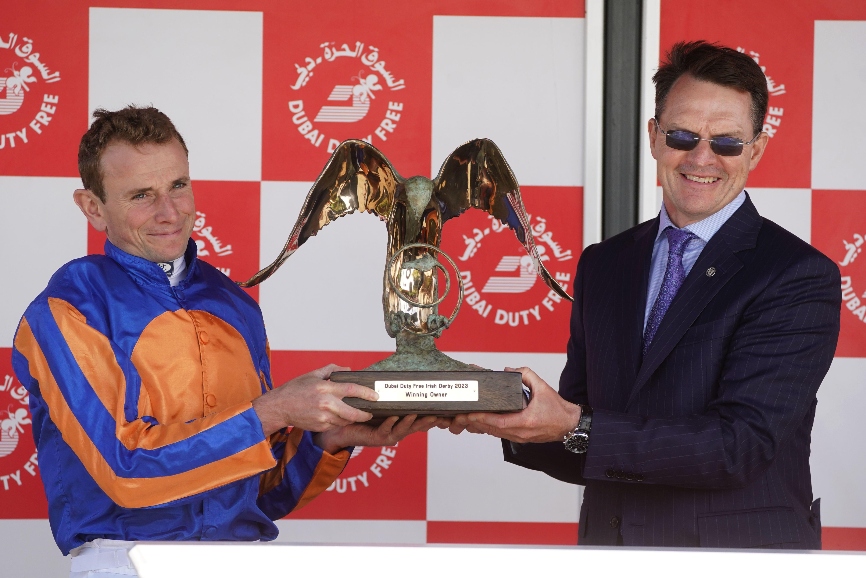
In our DAILY column POV – the terminally online racing and bloodstock enthusiast Ciarán Ó Deoráin on how to rejuvenate the Irish Derby…..
Lamenting the state of the modern-day Irish Derby is an exercise that has become all too common in recent years. As we make our way through June, one does not need to wait long to hear how reducing the Irish Derby trip to 10f would be the necessary shot in the arm for the Irish Classic.
However, claiming to support middle-distance racing while clamouring for a speedier version of the Irish Derby are in and of themselves arguments which cannot be easily reconciled. You want to support middle-distance racing by taking away one of the most recognisable 12f races in the calendar? Of course, the Irish Derby, for whatever reason, seems to unfairly bear the brunt of criticisms directed European middle-distance racing while other races seem to get off scot-free.
For example, the King George has thrown up winners in recent years such as Pyledriver, Hukum, and Goliath; as far as 12f types go, these three were on the stamina-laden end of things yet widespread debate about the commerciality of King George winners seems less commonplace than it does for those who take home the spoils in the Irish Derby.
There is nothing wrong with being inherently stamina-laden; those who refer to Derby winners as well as other top middle-distance types as either “slow” or “boats” would do well to remember that no-one would consider top 1,500m runners to be “slow” or “boats”. The real “slow” horses (And runners) are those who are nowhere near winning the biggest spoils in the sport.
Anyway, I don’t think anyone could plausibly dent that the Irish Derby is a pale shadow of what it once was. But people would do well to remember why that is. Between 1988 and 2007, there were 22 French-trained runners in the Irish Derby. Since 2007, Waldgeist in 2017 has been the only French-trained runner.
British-trained runners have not quite fallen off to the same extent but what has changed is the type of runner British handlers are sending across the Irish Sea. Between 1988 and 1993, five out of six British-trained Derby winners also ran in the Irish Derby, with Nashwan the only exception. Since then, North Light in 2004 was the only British-trained Derby winner to also run over 12f at the Curragh. Of course, Aidan O’Brien has won 11 renewals of the Derby since 2001 and one could argue that his dominance clouds matters. But for as successful as he has been at Epsom, he hasn’t won every year and the likes of Workforce, Golden Horn, Adayar, Desert Crown, and Masar could all easily have run at the Curragh.
So then…. how do we reinvigorate the Irish Derby without changing the distance? For me, a big player in its decline has been the reticence amongst French trainers to send their middle-distance types to Kildare in late June. Why go to the Irish Derby when you can run your horse in the Grand Prix de Paris instead? To be brutally honest, regardless of whether it has been run over 10f or 12f, the Grand Prix de Paris has not been a particularly strong G1. The French changed the Prix du Jockey Club trip as they felt their own Classic has to play second fiddle to Epsom; why run over 12f at Chantilly when you can do the same at Epsom?
While this change can be convincingly argued, there has to be give-and-take and unfortunately for the Irish Derby, there was no such give-and-take. In swapping the trips of the PdJC and the GPdP, the French managed to save the PdJC but at the expense of the Irish Derby. To my eyes, it is only fair that the French pay the price for changing the trip of the PdJC by demoting the Grand Prix de Paris to G2 status. This way, if French connections wanted their middle-distance types to contend for G1 glory against their own generation, their only possible option after the Derby would be the Irish Derby; the Irish Derby would look a good bit different this year if the likes of New Ground, Azimpour, and Midak were running in it.
Royal Ascot’s continued allure also has a part to play. Winning the King Edward VII is no small feat; some connections may value success at Royal Ascot so highly that they would rather win a G2 there than a G1 at the Curragh. While again, this is not a point without its merit, one must also remember the short gap between the King Edward VII and the Irish Derby. By moving the King Edward from its Friday slot to the Tuesday, King Edward VII runners would have another three days to recuperate in advance of the Irish Derby.
Finally, I believe that the powers-that-be should move the Eclipse back one weekend and the July Cup forward one weekend. Sprinters need less time to recover between their races and most Eclipse horses probably aren’t going to the King George anyway; the extra week would open up a greater gap between the Prince of Wales’s and the Eclipse but more pertinently (At least as far as this argument goes), there would be a two-week gap between the Irish Derby and the Eclipse. For as long as a one-week gap exists between the two races, it’s a case of one or the other (Unless you’re Saxon Warrior); a two-week gap opens up the possibility that a horse could take in both the Irish Derby and the Eclipse. There is of course no mechanism which automatically guarantees that connections will run eligible horses in both races but the option to race them in both could hardly hurt.
In sum, the Irish Derby has taken some heavy hits in the last twenty or so years. If we wish to preserve its status whilst also protecting European middle-distance racing, something must be done; an error of omission is an error all the same. In the absence of corrective action, the Irish Derby risks continuing down a road it has been ambling slowly along for a while now: the road to perdition.
Views of authors do not necessarily represent views of Star Sports Bookmakers.
Have a point of view? Email us at content@starsportsbet.co.uk!
STAR PROMOTIONS


Most Read

SIMON NOTT BETTING BLOG: Cheltenham S...
Dan had to scrape ice off his car...

SIMON NOTT BETTING BLOG: Cheltenham S...
Walking around the ring this...

RIO’S RACING STARS: Cheltenham ...
Hello and welcome to my new...


