


AUTHOR: Star Sports Content
LOOK SHARPE: Horsey Censor Humor?

Sports betting PR legend GRAHAM SHARPE brings you his latest ‘LOOK SHARPE’ column…
RACEHORSE OWNERS have tried all kinds of subterfuge in their efforts to slip dodgy names past the powers-that-be. It has been going on for years, with some efforts to do so quite subtle, others blatant.
For example, for reasons perhaps best known to himself, King William III’s most successful horse was blessed with the name Stiff Dick.
In 1809, Sir H T Vane’s Little Fanny, which ran at Northallerton, may well have had an entirely innocent meaning, and in 1822 I suspect racegoers will have admired the naming of Bedlamite, out of Maniac, a half-brother to Lunatic, by Prime Minister, a naming which demonstrates the high regard in which politicians were held in those days. Some things, of course, never change.
An 1840 dual winner at Tadcaster was named Prickbelt, landing one of his races after four other would-be runners were barred for apparently arriving late – however, these horses then took part in a meeting of their own – from which Prickbelt was banned, in a revenge ploy.
There was a mid-19th century runner called Sweetest When She’s Naked. Whether this horse featured in a race also involving an active equine of the time, Pudenda, seems not to be recorded.
Jumping some years ahead, the 1930 Yorkshire Cup was won by The Bastard. This horse was sent to Australia for stud duties, but his name was feared to be too ‘in your face’ for the delicate Aussies – and he was rechristened The Buzzard.
The late seventies saw Muff Diver winning in Belgium – this was around the time that Shy Talk was on the circuit. It has been said that the UK and USA are only divided by the same language, and for evidence of this it is interesting to note that in the 1980s a horse with a name unlikely to have found favour on this side of the pond was romping to eight victories – as the Pennsylvania Horse Breeders Association recorded: ‘Willy Wank secured a place in the hearts of longtime Pennsylvania racing fans by the time he retired in 1988 as the all-time leader by number of stakes wins (with nine) at Keystone Racetrack (now Parx Racing).
Bred and raised by his trainer Andrew Mukina, at Mukina’s farm near Erie, Pa., the gallant gelding campaigned for eight seasons, amassing a total of 86 starts, 18 wins, 14 seconds and 11 thirds, for earnings of $300,261.’ It appears that one of these 18 victories was achieved only by holding off the challenge of rival, Scorched Panties.
City ‘whizz kid, Alan Tappin, 32, was allowed in 1989 to name his two-year-old, Who Gives A Donald – far from innocent if one is aware of rhyming slang….
In 1991, punters at American track Del Mar were able to back a runner named bafflingly, Honk A Wanker.
Spoonerisms have appeared in some equine names – Julie Cecil-trained Mary Hinge chalked up five wins during 1993-4, possibly giving other owners an idea, as Joe Blob and Cunning Stunts were in action around the same time, while commentators were slowing down their words in 1994 when Weigh Anchor (pictured below) was active.
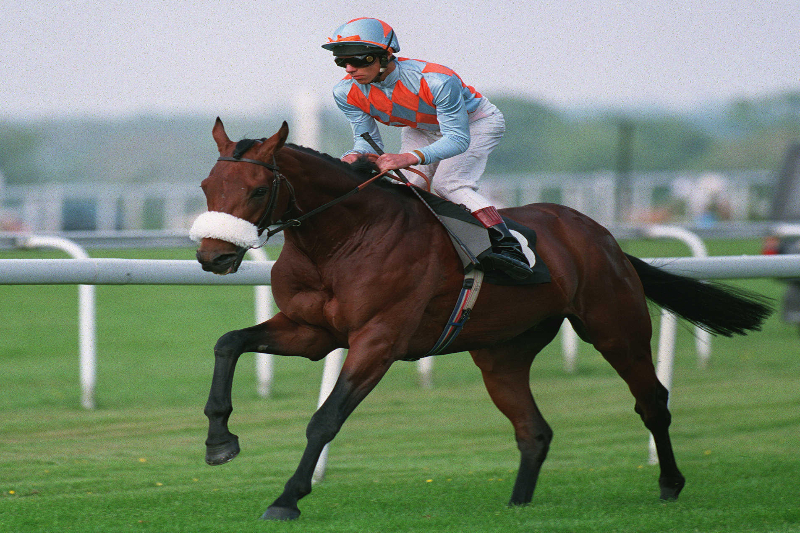
Also in 1993, the John Dunlop-trained Cazzuto had campaigned in Italy, where he had acquired his name, which apparently translates as ‘Dickhead’, although other translation services suggest ‘Badass’.
In 1994, commentators had to take care when 3yo Weigh Anchor was running. It might seem harsh on a horse to be banned because of a name, but that was the outcome in New Zealand in 1998 when authorities finally noticed how Tulsy Tsan’s name sounded when read backwards.
A leading American owner, Mike Pegram, whose best horse was probably the uncontroversially named, Captain Steve, was also the proud owner of salacious Isitingood and innocuous looking – until pronounced aloud with a prefix such as Pegram’s – Dixie Norma’s.
Jockey Club officials prevented a Richard Hannon late 1990s two-year-old from running as The Gobbler – who became, instead, Golden Ace.
In 2003, JC officials were not happy with a French raider who came over to race in the UK. Trainer, Elle Lalouche had been unable to get the name he’d wanted, Gros Nichons, past the French authorities, so translated it into the English equivalent, which they duly approved – Big Tits.
In July 2005, Owen Byrne of the Jockey Club revealed some of the names which had been rejected as unsuitable. Chocolate Starfish fell victim to the red pen, while Jack Meehof was hardy subtle and Sofa King Fast was speedily rejected; at least Wear The Fox Hat was an inventive effort – although his name eventually became Nameless – and Far Kinnell barely made it past the Starter.
In May 2006, Vince Smith trained a horse with one undescended testicle who won a juvenile maiden race – his name was Juan Bol.
In 2007, a syndicate called the Landing Strip Partnership gave Weatherbys a few hairy moments – naming a two-year-old Bollywood Style. Perfectly unremarkable as far as most would have been aware, but The Observer newspaper claimed that it meant: ‘To have the pubic area shaved and covered with Henna tattoo’. The same syndicate was also reportedly the owner of Bush Breakfast. Their colours? White with a black stripe.
In July of the year, Racing Post reader Jonny Allison commented on some runners he had noticed – ‘May I suggest a nursery restricted to three entrants – New Balls Please, Cute Ass and Little Knickers. Maybe the owners of Panty Raid could sponsor?’
Nothing ‘iffy’ or rude, but just funny – Arrr, a US gelding, ran at Saratoga in August 2008, not only producing a winning performance, but giving commentators and, no doubt, spectators, a great deal of fun as they pronounced the name in various accents.
Two horses became forever linked because of one race in 2010, run on August 22 at New Jersey’s Monmouth Park. The two raced together around the far turn, as ‘Mywifenosevrything’ beat ‘Thewifedoesntknow’ in a classic commentary.
There is also an unusual case of an international footballer acquiring a racehorse-related nickname – midfielder Colin Bell, of Manchester City, who won 48 England caps during the late 1960s and the 70s, became known as Nijinsky because of his great stamina, similar to that of the 1970 equine Triple Crown winner, Nijinsky, winner of the 1m 2000 Guineas, the one and a half mile Derby and the mile and three quarter St Leger. Bell died, aged 74 in 2008 and most of his obituaries referred to his nickname and also the equine superstar.
Views of authors do not necessarily represent views of Star Sports Bookmakers.
STAR PROMOTIONS


Most Read

#Top10: Q&A’s
In our new series #Top10 we pose...

GEORGE BOUGHEY: Weekend Preview
We have four runners on Friday...
#BettingPeople: PAUL JONES
#BettingPeople: Paul Jones is an...


