


AUTHOR: Star Sports Content
LOOK SHARPE: The Duque

Sports betting PR legend GRAHAM SHARPE brings you his latest ‘LOOK SHARPE’ column…
THERE HAS NEVER BEEN, and almost certainly never will be, another jockey like Spain’s 18th Duque de Albuquerque, aka Beltran de Osorio y Diez de Rivera.
As a young child in the early 1920s, the French aristocrat saw a film about the Grand National, fell in love with it, ultimately obsessively so, and vowed that this was a race in which he would one day ride – not only that, but he would win it, however long it may take.
His passion for horse had arisen after being given his first pony, at the age of five. Three years later, his father showed him a newsreel clip of the Grand National, which resulted in an enthusiasm for the idea of competing in it.
Showing great aptitude, the duke quickly became a very promising horse rider, rising to some prominence when he competed at the 1952, then the 1960 Summer Olympics.
The connection with the National story began in 1952 – his 34th year – when he achieved the first part of his ambition by riding in the National, partnering his own horse, Brown Jack II. His first attempt came to grief at the 6th fence when the rider and his mount both hit the deck – the Duque ended up in hospital with a cracked vertebra.
It took him a while to summon up the courage to have another go – eleven years in total. He returned on a mount named Jonjo – they stayed upright together until the 21st obstacle where they came down together – fortunately, neither of them suffering great damage.
Attempt number three came in 1965 when the Duque purchased and rode Groomsman. But, sadly, down they came at the 9th fence, as a result of which the Duque’s next stop was the hospital – where a broken leg was the diagnosis. Not the first injury of such nature – but no less than the 22nd time he had broken, or fractured, various parts of his body.
A year later, L’Empereur was the Duque’s next mount in the race. All went well enough until they reached the 26th, at which point the horse decided he’d done enough and pulled himself up.
Seven years now passed, during which time His Duque-ship went off elsewhere to get himself injured – sustaining a total of ten additional fractures.
However, back he came to Aintree for his fifth attempt – this time on seven-year-old Nereo. They were a neat combination of youngest horse and oldest jockey, and but for a leather which broke, causing them to pull up, might well have managed to complete the course.
Some weeks prior to the 1974 National, the Duque had an (other) accident in Seville, this one necessitating the insertion of 16 screws in his leg – which were removed only a fortnight before his latest tilt at the big race. Then, just a week before the race, he broke his collar bone. But, now 55, he finally completed the course at the sixth attempt, finishing eighth on Nereo in the process.
Flushed with his success, the Duque plotted a 1975 bid for glory – only to live up to his reputation as he broke a leg a week before the race. Even then, he was still planning to take part – until trainer Fred Winter pointed out that this might well be somewhat unfair on his intended mount, Nereo.
No surprise then, that a year later the Duque lined up for his magnificent seventh ride in the National. Racing up with the leaders, he and Nereo capsized at the 13th obstacle – ‘I have been superstitious of that number all my life’, bemoaned the disappointed Duque, as he once again took up residence in hospital. He’d been trampled on after the fall, and didn’t regain consciousness for longer than two days – coming round to discover that he had broken seven ribs, broken vertebrae, a broken wrist, a fractured right thigh bone – oh yes,as well as severe concussion.
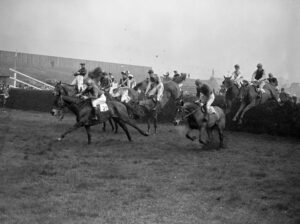
Would this mean the end of the line for the dashingly disaster-prone Duque? Almost everyone believed it would – except the gallant Duque himself, declaring, ‘I still want to return and complete the course of a Spanish horse.’
Now, though, at this point, the Jockey Club stepped in and refused His Duque-ship permission to ride over fences. Not only that – but they also introduced a new rule, requiring amateur riders of over fifty to undergo a stringent medical examination.
The Duque’s reaction? – ‘I was very sad. I trained hard for the 1977 National and considered myself fitter than I had been for years……..then they banned me.’
The Duque was declared medically unfit to ride in the race in 1977, but he continued to ride competitively in Spain until 1985 – at the age of 67. Beltran Alfonso Osorio y Díez de Rivera, 18th Duke of Alburquerque, The “Iron” Duke of Aintree, died on the 18th of February 1994 aged 76, without winning the Grand National.
Aussie jockey Fred Dummett, who rode in the late thirties and forties in Australia also had more than his fair share of injury problems – he fractured his right thigh three times, broke all of his ribs, his foot, his leg, his wrist, his collar bone – just the odd 29 times – oh, and had a cartilage removed – so he and I have at least something in common.
One jockey, recorded only as A Watson, was injured when riding Clem in a 6f sprint at Trentham in New Zealand, in July 1911 , only to break his leg – when it hit a spectator leaning over the inside rail in the home straight.
But surely the most seriously injured jockey to come back and ride again must have been Gerald Foljambe who, in 1925 returned to the saddle to ride a double over steeplechase fences at Leicester racecourse Melton, in 1925, despite having had a leg amputated below the knee.
However, jockey Tom Bruckshaw had to reassure people that the story reported in a Scottish local newspaper after he had fallen at Musselburgh in 1879 and been taken to hospital was slightly inaccurate – the paper had reported that the fall from his horse, Calyx, had been a fatal one – but Bruckshaw was far from dead – he lived to be 90 and died peacefully in his sleep.
And finally……..when 62 year old punter and racing fan Alan Rix, from Truro in Cornwall died in May, 1989, he was cremated in a coffin containing betting slips and a copy of the Sporting Life, then his ashes were scattered at Newton Abbot racecourse.
Views of authors do not necessarily represent views of Star Sports Bookmakers.
STAR PROMOTIONS


Most Read
SIMON NOTT BETTING BLOG: Cheltenham S...
Dan had to scrape ice off his car...
SIMON NOTT BETTING BLOG: Cheltenham S...
Walking around the ring this...

RIO’S RACING STARS: Cheltenham ...
Hello and welcome to my new...


